Author: sdhakad-yogapeace

Chandrabhedi Pranayama: The Cooling Breath to Balance Body and Mind

A warm and cheerful welcome to everyone!
We greet you all with a smile and welcome you to our program “Ek Kadam Swasthya Se Anand Ki Ore” (A Step from Health to Happiness).

Today’s topic is Chandrabhedi Pranayama.

This pranayama is especially beneficial for issues caused by excessive heat — such as mouth ulcers, stomach ulcers, excessive sweating, and body heat.

What is Chandrabhedi Pranayama?

The word “Chandrabhedi” literally means “that which provides coolness like the moon.”

Our body has two nostrils:

  • The right nostril represents the Surya Nadi (Sun Channel)
  • The left nostril represents the Chandra Nadi (Moon Channel)

When we inhale through the left nostril and exhale through the right nostril, it is called Chandrabhedi Pranayama.

This pranayama should be practiced mainly in the summer season.
It helps protect the body from all heat-related ailments.
You can perform it three times a day — morning, noon, and evening.

How to Practice Chandrabhedi Pranayama

  1. Sit comfortably in any meditative posture (such as Sukhasana or Padmasana).
  2. Keep your spine, neck, and head straight and aligned.
  3. Make sure there is no tension in the face or abdominal muscles.
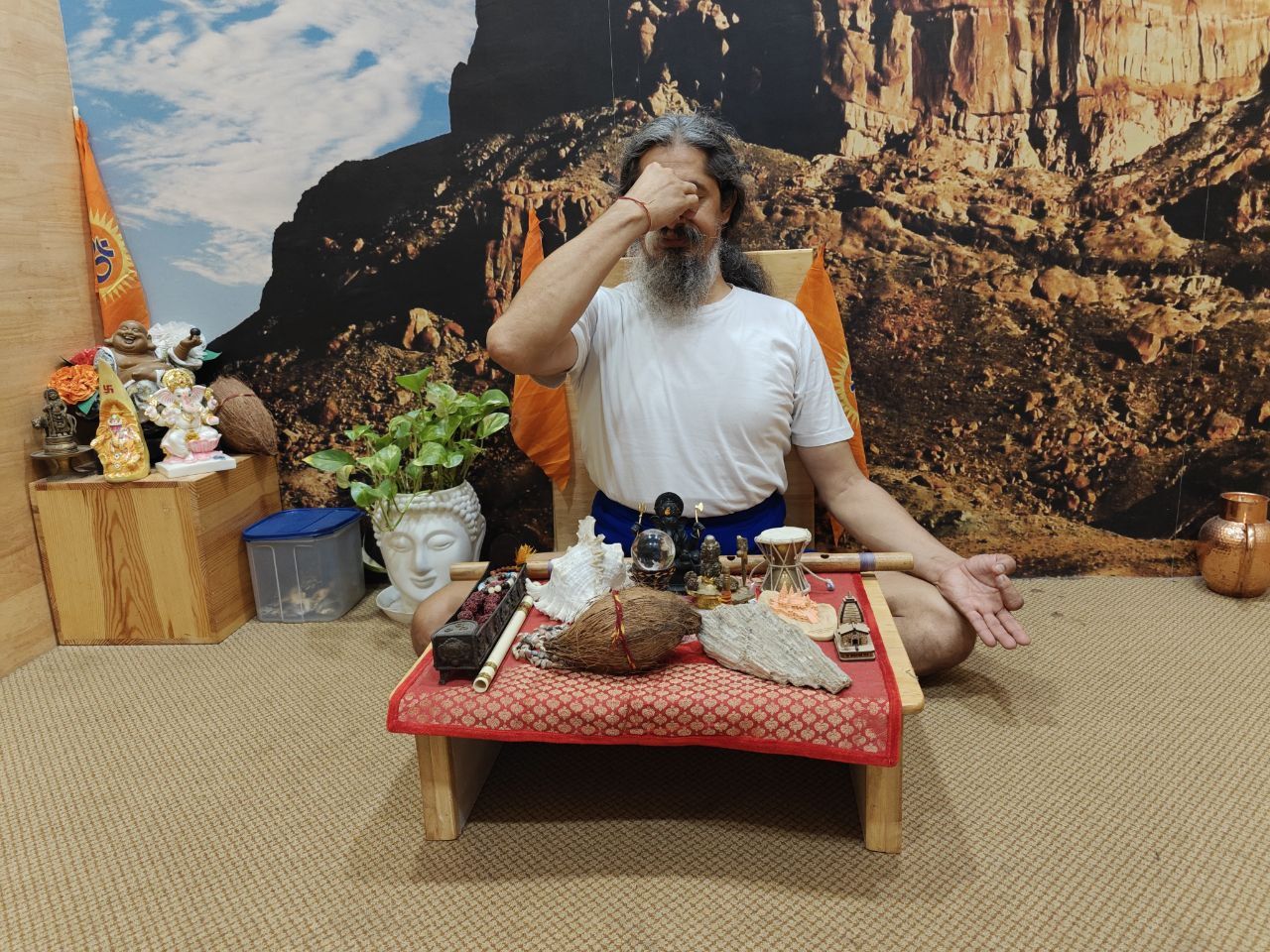
  4. Form the Pranayama Mudra with your right hand:
    • Place your index and middle fingers near the base of your thumb.
    • Close the right nostril with your thumb,
      and place your ring and little finger on the left nostril.
    • This hand position is also known as the Nasika Mudra.
  5. Close the right nostril and inhale slowly through the left nostril.
  6. Then exhale slowly through the right nostril.
  7. Repeat this breathing pattern several times.
  8. Once finished, close your eyes and observe the effects within your body.

Note:
The true benefit of any pranayama comes only through awareness and observation.
Just as we empty a bottle before refilling it with fresh water,
we must exhale old breath completely before taking in new pranic energy.

Precautions

  • Do not make any sound through the nose while inhaling.
  • Always inhale through one nostril and exhale through the other.
  • Keep your spine and neck straight.
  • The right arm should be raised parallel to the shoulder.
  • The nose should be aligned with the navel.
  • End the practice by inhaling through the left nostril.
  • Practice only during summer season, not in winter.

Benefits

  • Extremely beneficial for those with high blood pressure.
  • Brings coolness and calmness to the entire nervous system.
  • Helps relieve mouth ulcers, stomach ulcers, excessive sweating,
    heat strokes, nose bleeding (epistaxis), and burning sensation in the stomach.

Thank you very much for reading our article with attention and enthusiasm.

Yogacharya Dhakaram
Founder, YogaPeace Sansthan

Part 3 — Headstand (Shirsan with Triangle Support)

Dear friends,
Warm greetings and a smiling Namaste to all of you!
Welcome once again to our program “A Step from Health to Bliss.”

In the previous session, we discussed how to perform Headstand (Śīrṣāsana) more effectively. Those who find it difficult to balance in the headstand can take support of a wall.
If you are still unable to balance even with wall support, you can try doing Headstand with a Triangle Support (Trikon method).
As promised earlier, today we will learn how to perform Headstand in the triangle setup.


Important Guidance

Always practice Śīrṣāsana under the supervision of a qualified teacher or experienced practitioner.
Practicing the wrong alignment over a long period can disturb your body posture and spinal balance.


Why Practice Headstand in Triangle?

When doing a headstand against the wall, we often cannot tell if our body is straight or tilted.
Our legs may lean left or right, causing the posture to become imbalanced.
By using the triangle setup, your legs and body remain straight, ensuring proper alignment and balance.


Preparation for Headstand

  1. Mat or Blanket Setup
    • Length: around 2 feet
    • Width: around 2 feet
    • Height: 2–3 inches
      Fold the mat or blanket in a triangle shape and place it on the floor.
  2. Hand Position
    • Interlock your fingers.
    • Keep your elbows shoulder-width apart.
    • Form a triangle using your elbows and interlocked fingers.
  3. Head Position
    • Place the topmost part of the head on the floor.
    • Rest the palms gently on the raised part of the head for stability.
  4. Body Position
    • Raise your hips upward.
    • Gently bring your waist close to the triangle wall setup.
    • Slowly lift your legs upward so your body and legs align at the center of the triangle.

Duration of Practice

  • Beginners: 1–2 minutes
  • With regular practice: Up to 5 minutes
  • Breathing: Keep your breath normal.
  • Focus: Tighten the hips slightly and maintain steady balance.

Returning from the Posture

  1. Slowly bend your knees and lower your legs down.
  2. Come into Child’s Pose (Shashankasana).
  3. Rest your head on your hands and relax.
  4. After a while, lie down in Shavasana (Corpse Pose).
  5. Ensure that your neck is relaxed — lift your shoulders slightly to reduce pressure.

Benefits of Headstand

  • Brings radiance and glow to the face.
  • Helps maintain natural black hair.
  • Strengthens the digestive system.
  • Activates the endocrine glands, keeping hormones balanced.
  • Enhances mental focus, balance, and confidence.

Precautions

  • Never rush while performing the pose.
  • Avoid putting excess pressure on the neck.
  • Do not practice if you have back pain, neck pain, or shoulder issues.
  • The mat or blanket should be firm — not too hard or too soft.
  • People with high blood pressure should avoid this pose.
  • Keep your body centered within the triangle.

Dear friends,
With heartfelt respect, we bow to you all.
Stay happy, light, and blissful!

– Yogacharya Dhakaram
Founder, YogaPeace Sansthan
Part 2 — Headstand (Sirsasana with Wall Support)

Dear Friends,
Warm greetings to all of you with a smiling heart!
Welcome once again to our program “One Step from Health to Happiness.”
We hope you are doing great — because you all practice yoga regularly.


How to Practice Headstand with Wall Support

In our previous session, we discussed the basics of Sirsasana (Headstand).
Today, let’s learn how to improve the posture and maintain better balance using wall support, especially for those who find it difficult to balance independently.

Preparation

  • Use a blanket or yoga mat for comfort.
  • Ideal size: 2 feet long, 2 feet wide, and 2–3 inches thick.
  • Place it near the wall.

Step-by-Step Method

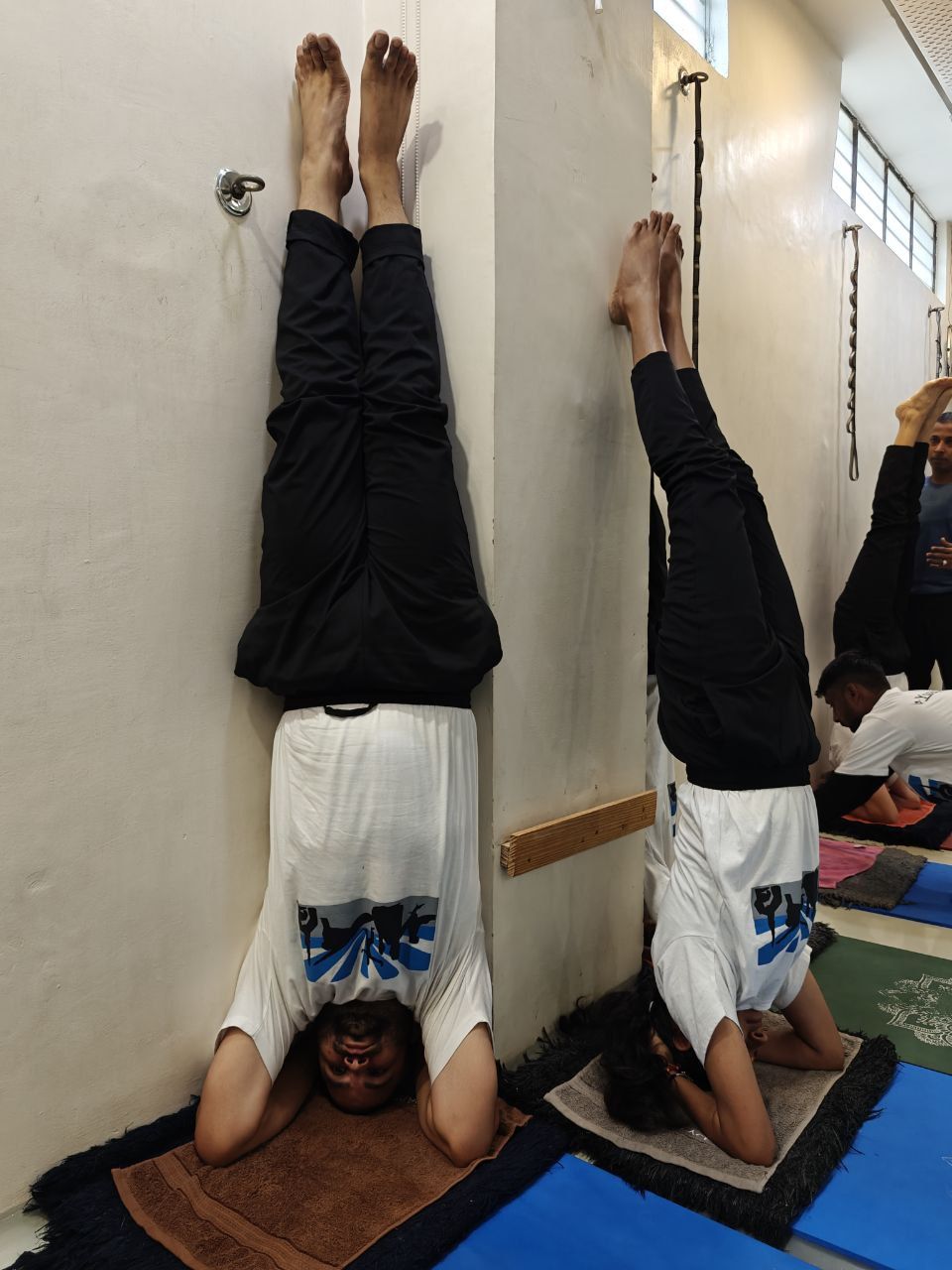
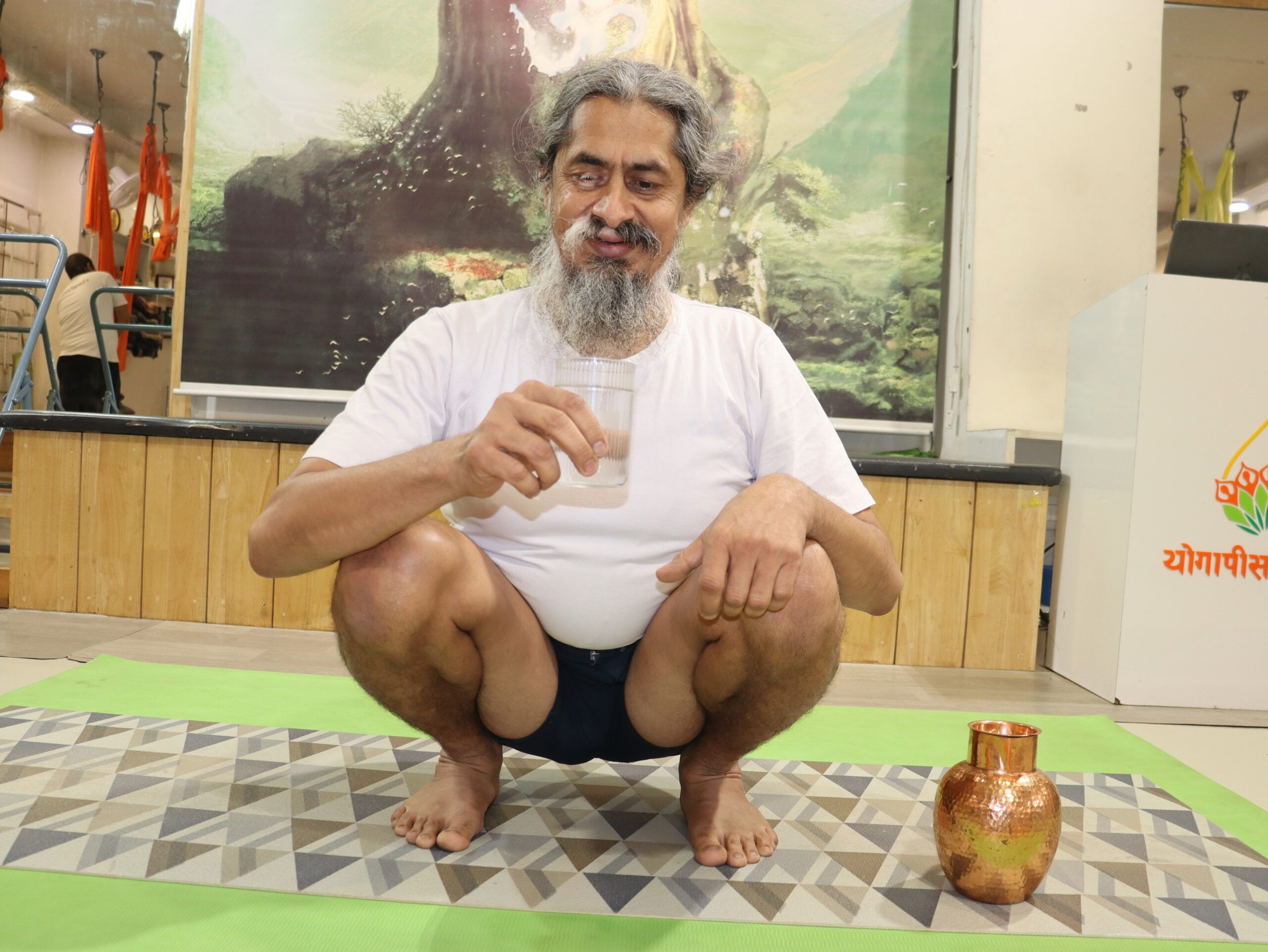
  1. Interlock your fingers firmly.
  2. Open your elbows and place them on the mat — keeping them shoulder-width apart.
  3. Face the wall and form a triangle with your elbows and fingers.
  4. Place the topmost part of your head on the mat.
  5. Support the back of your head with your palms.
  6. Lift your hips upward and bring your waist close to the wall.
  7. Once you can hold this position comfortably for 2–3 minutes without neck strain, slowly raise your legs up and rest them against the wall.

Key Points

  • Keep your hips contracted.
  • Try to balance your body steadily.
  • In the beginning, practice for 1–2 minutes only; gradually increase to 5 minutes.
  • Keep your breathing normal throughout.

Returning from the Posture

Slowly bend your knees and come down to Child’s Pose (Shashankasana).
Rest your head over your hands for a few moments.
Then lie down in Shavasana (Relaxation Pose) for complete rest.

⚠️ Note: Avoid putting too much pressure on the neck.
Keep your shoulders slightly raised to distribute the weight evenly.


Benefits of Sirsasana

  • Positively affects the entire body
  • Adds natural glow to the face
  • Helps keep hair dark and healthy
  • Strengthens the digestive system
  • Activates endocrine glands
  • Balances hormonal functions

Precautions

  • Never rush while performing the pose.
  • Avoid if you have neck pain, back pain, or shoulder injury.
  • Ensure the mat or blanket is neither too soft nor too hard.
  • People with high blood pressure should avoid Sirsasana.

Dear friends,
We bow to you all with heartfelt respect.
May you stay happy, joyful, and blissful always!

Yogacharya Dhakaram
Founder, YogaPeace Sansthan

Simple Yoga Practice for Shoulder and Neck Alignment

Namaste, Dear Friends

A smiling welcome to all of you in our program “Ek Kadam Swasthya Se Anand Ki Ore”A Step from Health to Happiness.
We hope you all are doing well — and of course, you are, because you practice yoga every day!


Recap of Previous Sessions

In our previous sessions, we discussed:

  • The right way to perform Headstand (Shirshasana)
  • The correct way to stand properly
  • The right posture for sitting

Today, let’s explore how to keep your shoulders and neck in perfect alignment.


Understanding Cervical & Neck Issues

In conditions like Cervical Spondylitis, the neck alignment often gets disturbed.

  • The upper back and neck tend to bend forward.
  • The shoulders become uneven.
  • Gradually, a slight hump appears on the upper back.

But don’t worry — with simple daily practice, this can be corrected naturally.


Yoga Practice for Shoulder and Neck Alignment

Step-by-Step Method

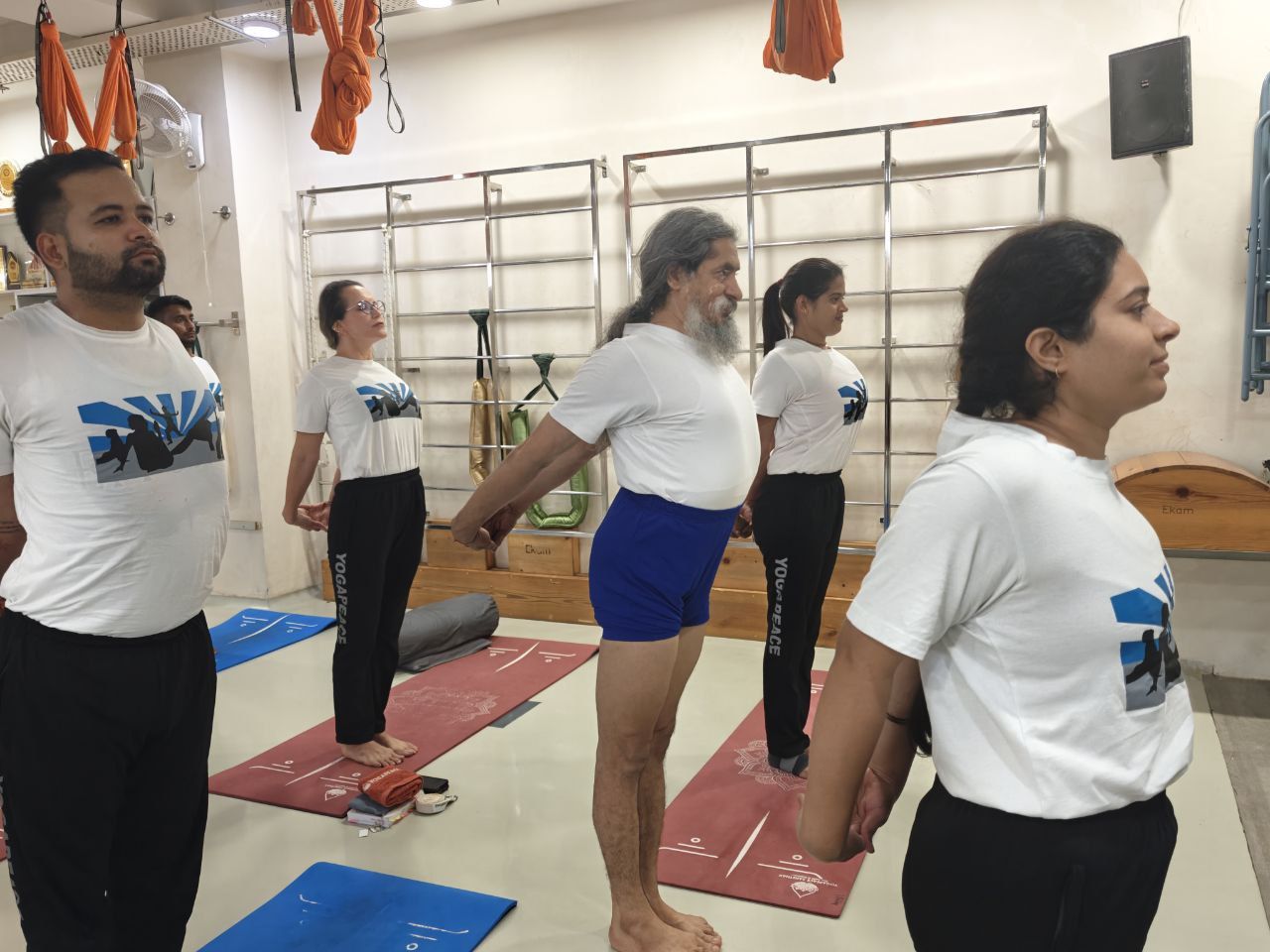
  1. Stand straight in Samsthiti (neutral position).
  2. Interlock your fingers behind your back.
  3. Stretch your arms backward and slightly upward.
  4. Keep your chest lifted and expanded.
  5. Close your eyes and keep your spine straight.
  6. Maintain this stretched position for at least one minute.
  7. Slowly release the posture —
    • Bring your hands back near your waist,
    • Hold one wrist with the opposite hand,
    • Relax your arms completely.
  8. With eyes closed, observe the changes in your body.

Who Should Practice This

This exercise is especially beneficial for:

  • Office workers who sit in front of computers all day,
  • Those who spend long hours looking down at mobile phones,
  • People who sit with a bent back for long periods.

👉 Practice this simple yoga stretch 3 to 4 times a day.
I can say with full confidence —
If you do it regularly, you will never experience shoulder or neck pain again.


A Gentle Reminder

Stay happy, relaxed, and blissful always. 🌸

– Yogacharya Dhakaram
Founder, YogaPeace Sansthan

Shirshasana (Part 1) – The King of Asanas

Dear friends, warm greetings to all of you!
Welcome once again to our article series “A Step from Health to Happiness.”

Today, we will talk about Shirshasana, also known as the King of Asanas.
The word “Shirshasana” comes from two Sanskrit words — ‘Shirsha’ meaning head and ‘Asana’ meaning posture.
It is considered one of the most powerful yoga poses because it activates the endocrine system and brings overall balance to the body.


Precautions and Preparation Before Doing Shirshasana

Even if you already know how to do Shirshasana, never perform it suddenly or to impress someone.
It is a spiritual and mindful practice, not a display of skill.

Remember, the skin on our head is much more sensitive than that of our feet. Therefore, stability, control, and safety are very important.


Steps to Practice Shirshasana

  1. Preparation:
    Use a folded blanket or a mat of about 2 feet in length and width, and 2–3 inches in height.
  2. Hand Position:
    Interlock your fingers and keep your elbows shoulder-width apart, forming a triangle with your forearms and hands.
  3. Head Position:
    Place the top of your head on the ground, and rest the cupped palms around the back of your head.
  4. Body Alignment:
    Keep your back straight. Bend your knees and slowly lift your legs off the floor.
    Straighten your legs upward, engaging your core muscles.
    Keep your hips tight and maintain your balance with normal breathing.
  5. Duration:
    In the beginning, stay for 1–2 minutes, and gradually increase to 5 minutes with regular practice.

Coming Out of the Pose

While coming down, bend your knees slowly and rest in Shashankasana (Child Pose).
Place your head on your hands and relax there for a while.
After that, lie down in Shavasana (Corpse Pose) for complete relaxation.

Ensure that there is no strain on your neck.
To avoid this, slightly lift your shoulders upward while balancing.


Benefits of Shirshasana

  • Brings natural glow and brightness to the face.
  • Helps prevent hair fall and promotes dark, healthy hair.
  • Strengthens the digestive system.
  • Activates the endocrine glands, keeping hormones balanced.
  • Brings overall health and vitality to the entire body.

Precautions

  • Never rush or jerk your legs upward.
  • Avoid any strain or pressure on the neck.
  • Always practice on an empty stomach and preferably under the guidance of a yoga teacher.

So dear friends, with heartfelt respect and love, we bow to you all.
In the next part, we will explore deeper insights and variations of Shirshasana.

Yogacharya Dhakaram
Founder – YogaPeace Sansthan

Special Birthday Song

Lyrics:

(आजका दिन आपका दिन)
(आजका दिन आपका दिन)
(आजका दिन आपका दिन)

जनम दिनकी शुभकामना
मुस्कुराते शुभकामना

(It’s your day and big day.)

Smile birthday to you.
जनम दिनकी शुभकामना

(ऐसे ही मुस्कुराना, खिलते खिलाते रहेना)

(भगवानकी अनुकम्पा, ऐसे बरसते रहेनना)
May god always bless you, and stay happy and healthy.

(Happy happy happy happy happy)

(Happy birthday to you)

(शभकामना, शुभकामना, शुभकामना आपको)

(Wish you………wish you)

(Smile birthday to you)
to you..

Pranayama – The Foundation of Exercise

Dear Friends, Warm Greetings to You All!

Welcome once again to our series “Ek Kadam Swasthya Se Anand Ki Ore” – A Step from Health to Happiness.

How are you, dear friends?
You must all say with a smile — “We are joyful and spreading happiness in this world!”
Let’s always stay cheerful, peaceful, and full of positive energy.


The Importance of Pranayama

Today, we will talk about Pranayama — the true foundation of all physical exercise.
No form of exercise is complete without pranayama.

You might wonder, “Why is that so?”
Read this article carefully and then reflect — you’ll realize how essential pranayama truly is.

In today’s time, most of us live with a lack of mental peace.
We do cycling, running, and other physical workouts —
but they often carry a spirit of competition, not calmness.
As a result, we strengthen our body but fail to relax our mind.


The Deep Connection Between Breath and Mind

You may have heard this truth —

“The deeper and longer your breath, the calmer your mind becomes.”

Or we can say —

“The calmer your mind, the deeper and steadier your breath.”

Our breath and mind are closely connected — each influences the other.
Therefore, it is essential to include Pranayama along with your daily exercise.

For peace of mind and emotional stability, practice pranayama regularly.
These three pranayamas are especially beneficial:

  • Kapalbhati Pranayama
  • Bhastrika Pranayama
  • Anulom Vilom Pranayama

Balancing Mental and Physical Strength

Just as a strong body is important, a strong and steady mind is equally vital.
If we are mentally weak, physical strength alone is of little use.
It is our mind that truly governs our body.

Modern life often brings stress and anxiety, which slowly impact our physical health as well.
Prolonged mental tension weakens the body over time.
Hence, maintaining mental balance is the key to overall health.

Just 15 Minutes for Yourself

All you need to do is devote 15 minutes daily to pranayama.
Practice consistently for 10 days, and notice the changes —
You will feel the difference in your body, mind, and emotions.
Within just a few days, your mind will become calmer, clearer, and more peaceful.


In Conclusion

Dear friends,
My humble salutations to all of you.
Stay happy, cheerful, and blissful always.

Thank you all for reading and being a part of this wellness journey.

Yogacharya Dhakararam
Founder – Yogapeace Sansthan

A Step Towards Health and Joy: Parvatasana

Hari Om 🙏 A smiling Namaskar to all of you.
We warmly welcome you to our program “A Step Towards Health and Joy.”

Currently, our blog series is focused on Surya Namaskar (Sun Salutation). In the previous post, we discussed Ashwa Sanchalan Asana (Equestrian Pose). Today, we will talk about Parvatasana (Mountain Pose).

Since the body takes the shape of a mountain in this posture, it is called Parvatasana. This asana is highly beneficial for the entire body. It stretches the muscles, builds strength, and calms the mind.

How to Move from Ashwa Sanchalan Asana to Parvatasana

  • In Ashwa Sanchalan Asana, the right leg is placed back.
  • To come into Parvatasana, lift your hips upward and slowly take the left leg back as well.
  • Align the heel of the left foot with the heel of the right foot.
  • Pull the hips and lower back upward.
  • Keep the head between the arms.
  • Both legs should remain straight and the heels touching the ground.
  • The hips should remain lifted upward towards the sky.

Points to Remember While Practicing Parvatasana

  • Keep the knees straight.
  • Try to press the heels onto the ground.
  • Maintain body balance and try to stay in this posture for at least 20 seconds.

Benefits of Parvatasana

  • Strengthens the shoulders.
  • Very beneficial for the legs.
  • Improves blood circulation to the head, bringing glow to the face.
  • Keeps the brain active and healthy.
  • Makes the spine flexible.

Special Note

While performing Parvatasana, the face remains downward, which increases the blood flow towards the head and face. This enhances skin health, freshness, and radiance.

A Glimpse of the Next Blog

Dear friends, in the next blog of the Surya Namaskar series, we will talk about Bhujangasana (Cobra Pose). Stay connected with us and keep reaping the benefits of yoga for your health.

So, dear friends, salutations to all of you.
Stay happy, cheerful, and blissful always. 🌸

Yogacharya Dhakaram
Founder – YogaPeace Institute

Solution for Stomach Problems – Part 2

Dear Friends,

A warm and smiling welcome to all of you!
We greet you once again in our article series “One Step from Health to Happiness.”


Today’s Topic – How to Practice Vajrasana If You Have Knee Pain

In the previous article, we discussed how Vajrasana strengthens the digestive system.
Today, we’ll understand how it does so,
and how people who experience knee pain can still perform Vajrasana safely with the help of props or supports.


How Vajrasana Strengthens the Digestive System

It is said that just above our buttocks lies the Braj Nadi (nerve channel).
When we sit in Vajrasana, the pressure of the heels activates this Braj Nadi.
This nadi is connected to the large intestine, and when it becomes active,
it helps to stimulate and strengthen the digestive system.

Additionally, when you sit in Vajrasana, blood flow to the legs and thighs slightly decreases,
which allows more blood circulation in the abdominal area.
This enhanced blood flow aids in better digestion and metabolism.


How to Do Vajrasana with Props (for Knee Pain)

If you have knee discomfort, you can still enjoy the benefits of Vajrasana using props such as a cushion, bolster, or folded blanket.

Method 1: Using a Small Cushion or Bolster

  1. Take a small round cushion or bolster.
  2. Sit in Vajrasana position.
  3. Place the cushion under your ankles.
  4. Keep your spine straight and heels together.
  5. Close your eyes and relax in a meditative state.

Method 2: Using a Cushion and Pillow

  1. Sit first in Dandasana (legs stretched forward).
  2. Slowly bend your legs and come into Vajrasana position.
  3. Place a small cushion under your ankles.
  4. Keep a pillow between your calves and thighs.
  5. This setup reduces pressure on your knees and makes sitting more comfortable.

👉 If you don’t have a bolster or cushion, you can use a pillow, folded bedsheet, or blanket instead.


Benefits of Vajrasana

  • Strengthens the digestive system.
  • Prevents indigestion, gas, acidity, and bloating.
  • Promotes proper digestion when practiced after meals.
  • Enhances blood circulation in the abdominal region.
  • Improves calmness and focus during meditation.

Precautions

  • Those with knee pain should use props and avoid sitting directly on the heels.
  • Keep your spine straight while sitting.
  • Practice right after meals, but do not sit for too long.

Conclusion

Practicing Vajrasana after meals helps relieve acidity, bloating, and digestive issues naturally and effectively.

So dear friends,
Warm regards and heartfelt greetings to all of you.
Stay happy, cheerful, and blissful always! 🌸

Yogacharya Dhakararam
Founder – Yogapeace Sansthan

Solution for Stomach Problems – Part 1

Dear Friends,

A warm and smiling welcome to all of you!
We greet you in our program “Ek Kadam Svasthya Se Anand Ki Ore”One Step from Health to Happiness.

Dear friends, how are you?
Say it aloud — I am joyful!
We all must spread happiness in this world.
Always stay cheerful — because you are alive!

Many people go to sleep at night and never wake up in the morning.
So, be grateful and stay joyful — because God has created you for a special purpose.


Today’s Topic – Vajrasana (Thunderbolt Pose)

Today, let’s talk about Vajrasana
its correct method, precautions, and important tips.

According to our ancient yogic texts, Vajrasana is the only asana that can be practiced after eating food.
It strengthens the digestive system, helps relieve indigestion and gas, and promotes overall stomach health.
While modern understanding allows for certain gentle postures after meals,
the scriptures specifically recommend Vajrasana as the most beneficial.


Why Vajrasana is Important

Most health issues begin with poor digestion.
If our food digests properly, the body remains healthy and diseases stay away.

Vajrasana enhances the digestive process and thus can be considered a powerful remedy for stomach problems.


How to Practice Vajrasana

  1. Sit with both legs stretched straight in front of you (in Dandasana).
  2. Fold your right leg and place it under the right buttock.
  3. Fold your left leg and place it under the left buttock.
  4. Keep your spine straight.
  5. Join both heels together.
    • If this feels difficult, allow the heels to fall slightly outward and join the toes instead.
  6. While sitting, gently move the skin of the calves outward.
  7. Place both palms on your thighs.
  8. Close your eyes and relax in a meditative state.

You can sit in Vajrasana while watching TV or doing other light activities —
but the best time to practice is after meals, focusing on your breath and maintaining calm awareness.


Benefits of Vajrasana

  • Strengthens the digestive system.
  • Prevents indigestion and gas problems.
  • Activates abdominal organs and improves their functioning.
  • Helps in secretion of enzymes and hormones.
  • Keeps bones flexible and strong.

Precautions

  • People with knee pain should avoid this posture directly.
  • Keep your back straight while sitting.

Next time, we’ll share how people with knee discomfort can practice Vajrasana using props or support.


In Conclusion

So dear friends,
Warm regards and gratitude to all of you. 🙏

Yogacharya Dhakararam
Founder – Yogapeace Sansthan