



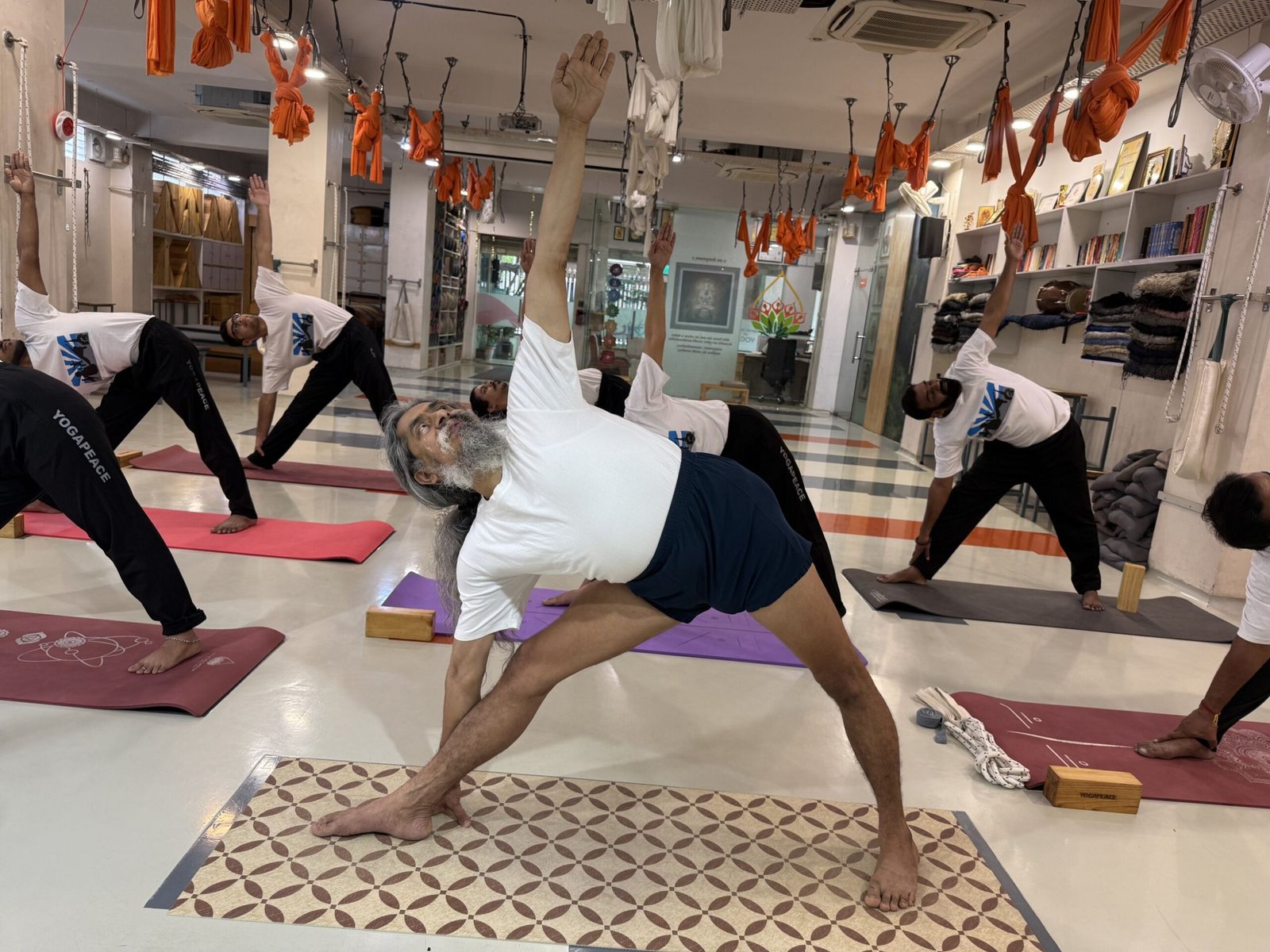
Yoga is much more than physical exercise. It is an ancient practice that helps establish harmony between the body, breath, and mind. Among the various yoga postures, Utthita Trikonasana (Extended Triangle Pose) is an important standing asana that combines stability, flexibility, balance, and body awareness.
This posture involves standing with the legs apart, extending the torso sideways, and stretching the arms in opposite directions to create a triangular shape with the body.
Utthita Trikonasana can help strengthen the muscles of the legs, improve flexibility in the hamstrings and hips, enhance balance, and encourage greater mobility in the chest and shoulders.
Practising this asana with correct alignment, natural breathing, and awareness of one’s physical limitations is essential.Beginners may use a yoga block or wall for support. Meanwhile, experienced practitioners can gradually work on improving their alignment, stability, and practice duration.

1. What Is Utthita Trikonasana?
Utthita Trikonasana, commonly known as Extended Triangle Pose, is a standing yoga posture in which the feet are placed apart and the torso is extended sideways.
One hand reaches down towards the leg or the floor, while the other extends upwards, creating a triangular structure.
The practice particularly involves the legs, hips, spine, shoulders, and the sides of the torso.
The purpose of this asana is not simply to bend sideways but to develop stability, extension, balance, and coordination between movement and breathing.
When performed correctly, the posture encourages a sense of openness throughout the body while improving awareness of physical alignment.
2. Meaning and Origin of Utthita Trikonasana
The Sanskrit name Utthita Trikonasana consists of three words:
- Utthita: Extended, stretched, or raised.
- Trikona: Triangle, a geometrical shape with three angles.
- Asana: A physical posture or position.
Together, these words mean Extended Triangle Pose.
In this posture, the legs are positioned apart, the torso extends sideways, and the arms reach in opposite directions to form a triangular structure.
Utthita Trikonasana is widely practised in modern yoga traditions to improve flexibility, stability, balance, and postural alignment.
It is particularly valuable for developing coordination between the lower body, spine, shoulders, and breath.
3. How to Perform Utthita Trikonasana: Step-by-Step Instructions
Utthita Trikonasana should be practised gradually and systematically. Each step requires attention to body alignment, natural breathing, and physical comfort.
Step 1: Begin in a Standing Position
- Stand upright with both feet together.
- Keep your spine naturally straight.
- Relax your shoulders and release unnecessary tension.
- Allow your breathing to remain normal and comfortable.
- Become aware of your body weight and balance.
Join India’s most demanding Yoga Teacher Training Program : Yoga Teacher Training TTC

Step 2: Separate Your Feet
- Inhale and gradually move your feet approximately 3 to 3½ feet apart.
- Beginners may perform this movement while breathing naturally.
- Turn your right foot approximately 90 degrees outward.
- Turn your left foot approximately 60 degrees inward.
- Keep both legs straight and active without excessively locking the knees.
- Distribute your body weight evenly and maintain stability.


The distance between the feet may be adjusted according to your height, flexibility, and comfort.
Step 3: Extend Your Arms and Lengthen the Side of Your Body
- Slowly raise both arms sideways to shoulder height.
- Keep your palms facing down.
- Stretch both arms in opposite directions, maintaining a straight line through the shoulders.
- Gently extend your arms while keeping the shoulders comfortable.
- Now slowly raise your right arm above your head.
- Stretch the right arm upwards and lengthen the right side of your torso.
- Feel the extension through the right ribs, armpit, and shoulder.


This initial extension helps prepare the torso for the sideways movement.
Step 4: Bend Your Torso Towards the Right
- Inhale deeply and extend your right arm further upwards.
- While exhaling, slowly begin bending towards the right.
- Maintain the length and extension created through the right side of your body.
- Initiate the movement from the hip joint rather than simply bending the waist.
- Avoid leaning excessively forward or backward.
- Keep your chest open and your spine elongated.
- As you inhale, feel your spine lengthening.
- As you exhale, gently rotate your chest upwards, within your comfortable range, to create greater openness through the chest.
Want to make your life healthier and happiest : Join our Anandam sessions daily

The emphasis should remain on sideways extension rather than forcing the body downward.
Step 5: Position Your Hands Correctly
- Place your right hand against your right shin or near the ankle.
- If reaching lower compromises your balance or spinal alignment, use a yoga block or a stable, low stool for support.
- Extend your left arm upwards.
- Try to keep both arms approximately aligned in opposite directions.
- Maintain a gentle sense of extension through both arms.
Remember that touching the floor is not the objective of this posture. Maintaining correct alignment is far more important.
Step 6: Position Your Head, Neck, and Gaze
- Keep your neck comfortable and free from unnecessary tension.
- If your neck allows, gently turn your head to look towards your raised hand.
- If you experience cervical discomfort, neck stiffness, or shoulder problems, keep your gaze forward or downward.
- Avoid forcefully rotating your neck.
Your gaze should support balance and comfort rather than create additional strain.
Step 7: Hold the Posture with Natural Breathing
- Once you have established the posture, continue breathing normally.
- Depending on your ability, try to maintain the position for approximately 45 seconds to 1 minute.
- Beginners may hold the posture for a shorter duration.
- Observe the stretching sensations through your legs, spine, ribs, and shoulders.
- Remain aware of your breathing and body alignment.
- Avoid holding your breath or placing excessive pressure on any joint.

The posture should feel stable and controlled rather than forced.
Step 8: Return to the Starting Position
- Inhale and gradually lift your torso back to an upright position.
- Bring your right arm back from above your head to shoulder level.
- Extend both arms sideways for a moment.
- Slowly lower your arms.
- Bring your feet together and return to the initial standing position.
- Relax for approximately 15 to 20 seconds.
During this brief relaxation, observe the sensations in your legs, breathing, and mind.
You may notice a feeling of lightness in the right leg or a sense of calmness in the body.
After allowing the body and mind to relax, repeat the same sequence on the opposite side.
Finally, return to a comfortable standing position and observe the overall sensations in your body, breath, and mind.
Important: If you experience pain, dizziness, or unusual discomfort during practice, slowly release the posture and stop the exercise.
Watch the full video for more info and practice 👉 Utthita Trikonasana
4. Major Benefits of Utthita Trikonasana
Utthita Trikonasana offers several potential physical and mental benefits when practised regularly with proper technique.
4.1 Helps Strengthen the Legs and Ankles
Utthita Trikonasana requires the legs to remain active and stable while the torso extends sideways.
This engages the muscles of the thighs, calves, ankles, and other muscles responsible for maintaining balance.
Regular practice may help improve muscular endurance, stability, and functional strength in the lower body.
4.2 Improves Hamstring and Hip Flexibility
The posture creates a gentle stretch through the hamstrings, which are located at the back of the thighs, and the muscles surrounding the hips.
With consistent practice and correct alignment, flexibility in these areas may gradually improve.
This can also contribute to more comfortable movement in everyday activities.
4.3 Supports Better Body Balance
In this asana, the feet remain grounded while the torso and arms move into an extended position.
Maintaining this alignment requires coordination, muscular control, and awareness of body position.
Regular practice may improve balance, stability, and proprioception—the body’s ability to sense its position and movement.
4.4 Encourages Chest and Shoulder Mobility
Extending the arms in opposite directions and keeping the chest open creates a stretch through the shoulders, ribs, and upper torso.
This may improve mobility in these areas and encourage greater awareness of natural, comfortable breathing.
4.5 Helps Improve Postural Awareness
Utthita Trikonasana encourages practitioners to lengthen the spine, open the chest, and maintain appropriate shoulder alignment.
These actions can increase awareness of posture and encourage better movement patterns.
4.6 Encourages Breath Awareness and Concentration
Maintaining a stable posture while breathing naturally requires attention and coordination.
This helps practitioners become more aware of their breathing, body position, and physical sensations.
It may also support concentration, mindfulness, and a calmer state of mind.
Overall Benefits
Utthita Trikonasana can be particularly beneficial for developing mobility, strength, and stability around the ankles, calves, knees, thighs, hips, spine, and shoulders.
Its effectiveness depends on regular practice, correct technique, and individual physical ability.
5. Muscles Involved in Utthita Trikonasana
Utthita Trikonasana engages several important muscle groups throughout the body.
- Hamstrings: Located at the back of the thighs, these muscles experience stretching during the posture.
- Oblique Muscles: The muscles along the sides of the abdomen help stabilise and control the torso.
- Gluteal Muscles: These muscles support hip stability and pelvic control.
- Thigh Muscles: The quadriceps and other thigh muscles help maintain leg stability and control knee positioning.
- Calf and Ankle Muscles: These muscles contribute to balance and stability while standing.
- Shoulder and Upper Back Muscles: These muscles help maintain the extended arm position and support chest alignment.
The degree of muscular engagement varies according to individual flexibility, anatomical structure, posture, and technique.
6. Common Mistakes to Avoid in Utthita Trikonasana
Practising the pose correctly is essential to receive its benefits and reduce unnecessary strain.
6.1 Leaning Too Far Forward or Backward
Utthita Trikonasana primarily involves sideways extension of the torso.
Excessive forward or backward leaning may disturb spinal and chest alignment.
Correction: Keep the torso extended sideways and use a yoga block or stable support whenever required.
6.2 Putting Excessive Pressure on the Knees
Overstraightening or locking the knees can create unnecessary strain.
Practitioners with knee hyperextension should be particularly careful.
Correction: Keep the knees stable and controlled. Maintain a slight softness in the joints when necessary, and use suitable support under professional guidance.
6.3 Straining the Neck
Forcefully turning the head upwards can create tension or discomfort in the neck.
Correction: Keep the neck relaxed. Look forward or downward if turning upwards feels uncomfortable.
6.4 Trying Too Hard to Touch the Floor
Every individual has a different level of flexibility.
Attempting to touch the floor at the expense of proper alignment may cause unnecessary strain.
Correction: Place your hand on the shin, ankle, or a yoga block. Focus on maintaining spinal length and stability.
6.5 Holding the Breath
Holding the breath is neither necessary nor recommended while maintaining the posture.
Correction: Continue breathing naturally and comfortably throughout the practice.
7. Precautions and Safety Tips for Utthita Trikonasana
Although Utthita Trikonasana is commonly practised, certain precautions should be followed.
- If you have an injury involving the back, neck, knees, or hips, consult a qualified healthcare professional or experienced yoga therapist before practising.
- Use a wall or yoga block if you find it difficult to maintain balance.
- Avoid forcing the neck to look upwards if you experience discomfort.
- During pregnancy, practise only after consulting your healthcare provider and a yoga instructor trained in prenatal yoga.
- If you have high blood pressure or another medical condition, seek appropriate professional guidance and modifications.
- Stop practising if you experience dizziness, pain, or unusual discomfort.
- Beginners should prioritise correct alignment, comfortable breathing, and stability rather than holding the pose for longer periods.
The most important principle is to respect your body’s limits and practise without force.
8. Utthita Trikonasana for Beginners
Beginners can make Utthita Trikonasana safer and more comfortable by adopting a few simple modifications.
Use a Yoga Block
Instead of attempting to place your hand on the floor, use a yoga block or stable, low stool.
This helps maintain spinal length and reduces the need to bend excessively.
Practise Near a Wall
If you have difficulty maintaining balance, perform the posture near a wall for additional support.
Adjust the Distance Between Your Feet
Avoid spreading your legs too widely at the beginning.
Choose a distance that allows you to remain stable while extending the torso sideways.
Start with a Shorter Duration
Initially, hold the posture for approximately 15 to 30 seconds on each side.
Gradually increase the duration as your stability and flexibility improve.
Practise Tadasana Beforehand
Before attempting Utthita Trikonasana, practise Tadasana (Mountain Pose) and gentle warm-up movements.
These preparations can improve body awareness, activate the muscles, and encourage comfortable joint mobility.
The fundamental principle of yoga is not to force the body into a particular shape but to develop its capabilities gradually and mindfully.
9. Variations of Utthita Trikonasana
Different variations and modifications can help practitioners adapt the posture according to their experience and physical ability.
9.1 Supported Triangle Pose
In this variation, the lower hand rests on a yoga block or another stable support.
This may be particularly useful for beginners and individuals with limited flexibility.
9.2 Gaze Variations
Depending on neck mobility and comfort, practitioners may look upwards, straight ahead, or downwards.
Those experiencing neck discomfort may find a forward or downward gaze more comfortable.
9.3 Adjusting the Distance Between the Feet
Beginners may reduce or adjust the distance between their feet to maintain better balance.
The stance should provide enough stability to allow comfortable sideways extension without unnecessary strain.
10. Best Time and Duration for Utthita Trikonasana
Utthita Trikonasana can be incorporated into a regular yoga routine after Tadasana and suitable warm-up exercises.
Beginners may start by holding the posture for approximately 15 to 30 seconds on each side.
As flexibility, stability, and confidence develop, this duration may gradually increase to 45 seconds or approximately 1 minute.
When determining the appropriate duration, consider:
- Your physical strength and flexibility.
- Stability in the legs and torso.
- The ease and rhythm of your breathing.
- Comfort in the knees, back, and neck.
- Your ability to maintain concentration without strain.
Yoga is not a competition to hold a posture for the longest possible time. Correct technique, consistency, and awareness are far more important.
11. Yoga Poses Related to Utthita Trikonasana
Several other standing yoga postures can complement Utthita Trikonasana.
Trikonasana (Triangle Pose)
Trikonasana is a general term for Triangle Pose and may be used in different contexts across yoga traditions.
It involves stability, sideways extension, and coordination between different parts of the body.
Virabhadrasana II (Warrior II Pose)
This standing posture helps develop leg strength, stability, endurance, and balance.
Parsvakonasana (Side Angle Pose)
Parsvakonasana encourages lower-body engagement while stretching the sides of the torso.
These postures may be included in a balanced yoga sequence according to individual ability and the guidance of a qualified instructor.
12. Frequently Asked Questions About Utthita Trikonasana
Q1. What are the main benefits of Utthita Trikonasana?
Utthita Trikonasana may help strengthen the legs, improve hamstring and hip flexibility, enhance balance, encourage chest and shoulder mobility, and develop greater body awareness.
Q2. How long should I hold Utthita Trikonasana?
Beginners may start by holding the posture for 15 to 30 seconds on each side.
With regular practice, the duration can gradually increase to 45 seconds or approximately 1 minute.
Maintaining correct alignment and comfortable breathing is more important than the duration.
Q3. Can beginners practise Utthita Trikonasana?
Yes. Many beginners can practise this posture with appropriate guidance and suitable support, such as a yoga block or wall.
Q4. Does Utthita Trikonasana improve flexibility?
Regular practice may help improve flexibility in the hamstrings, hips, and sides of the torso.
The results depend on individual physical condition, consistency, and technique.
Q5. Can Utthita Trikonasana help with weight loss?
Practising Utthita Trikonasana alone does not guarantee weight loss.
Effective weight management generally requires a balanced diet, regular physical activity, adequate sleep, and a healthy lifestyle.
However, this asana can be a useful component of an overall fitness and wellness routine.
Q6. Can I practise Utthita Trikonasana if I have neck problems?
Individuals with neck discomfort may need to avoid looking upwards.
Keeping the head in a neutral position and looking forward or downward may be more comfortable.
Q7. How should I breathe during Utthita Trikonasana?
Breathe naturally while entering the posture and continue normal, comfortable breathing while holding it.
Maintain controlled breathing as you return to the standing position.
There is no need to forcefully hold your breath.
Conclusion
Utthita Trikonasana (Extended Triangle Pose) is an important yoga posture that combines stability, flexibility, balance, and body awareness.
When practised regularly with correct technique, it may improve muscular engagement and mobility in the legs, hips, spine, chest, and shoulders.
The true essence of this posture goes beyond creating a triangular shape with the body. It lies in experiencing extension, balance, natural breathing, and awareness throughout the practice.
Yoga is not merely about performing difficult postures. Its deeper purpose is to develop harmony between the body, breath, and mind.
By incorporating Utthita Trikonasana into a regular yoga routine under appropriate guidance, practitioners can take a meaningful step towards improved physical wellbeing, mental calmness, and greater self-awareness.
Book a free consultation for Teacher Training Program, Click Here 👉 Free Consultation
Yogacharya Dhakaram
Founder, YogaPeace Sansthan
