



What Is Kati Shakti Vikasak ?
Yoga offers several exercises designed to improve muscular strength, flexibility, mobility and overall physical well-being. One such practice is Kati Shakti Vikasak, a traditional yogic exercise that focuses primarily on the waist, lower back and spinal region.
The Sanskrit word Kati means waist or lower back, while Shakti Vikasak means that which develops strength. Together, Kati Shakti Vikasak refers to an exercise intended to develop strength, mobility and flexibility in the waist and lower back.
This exercise involves gently bending the body backwards and forwards in coordination with breathing. When performed correctly and regularly, it may help activate the muscles surrounding the spine, maintain spinal mobility, improve body awareness and support better posture.

However, it is essential to practise within your physical capacity, without forcing movements or holding your breath.
How to Practise Kati Shakti Vikasak
The exercise can be performed in three simple stages.
1. Starting Position
- Stand upright with both feet together.
- If maintaining balance with your feet together is difficult, keep them slightly apart.
- Make a fist with your left hand, keeping the thumb inside the fist.
- Hold your left wrist with your right hand.
- Position both hands behind your waist.
- Keep your elbows directed backwards and your chest comfortably open.
- Distribute your body weight evenly across both feet.
- Keep your shoulders relaxed and maintain a comfortable upright posture.
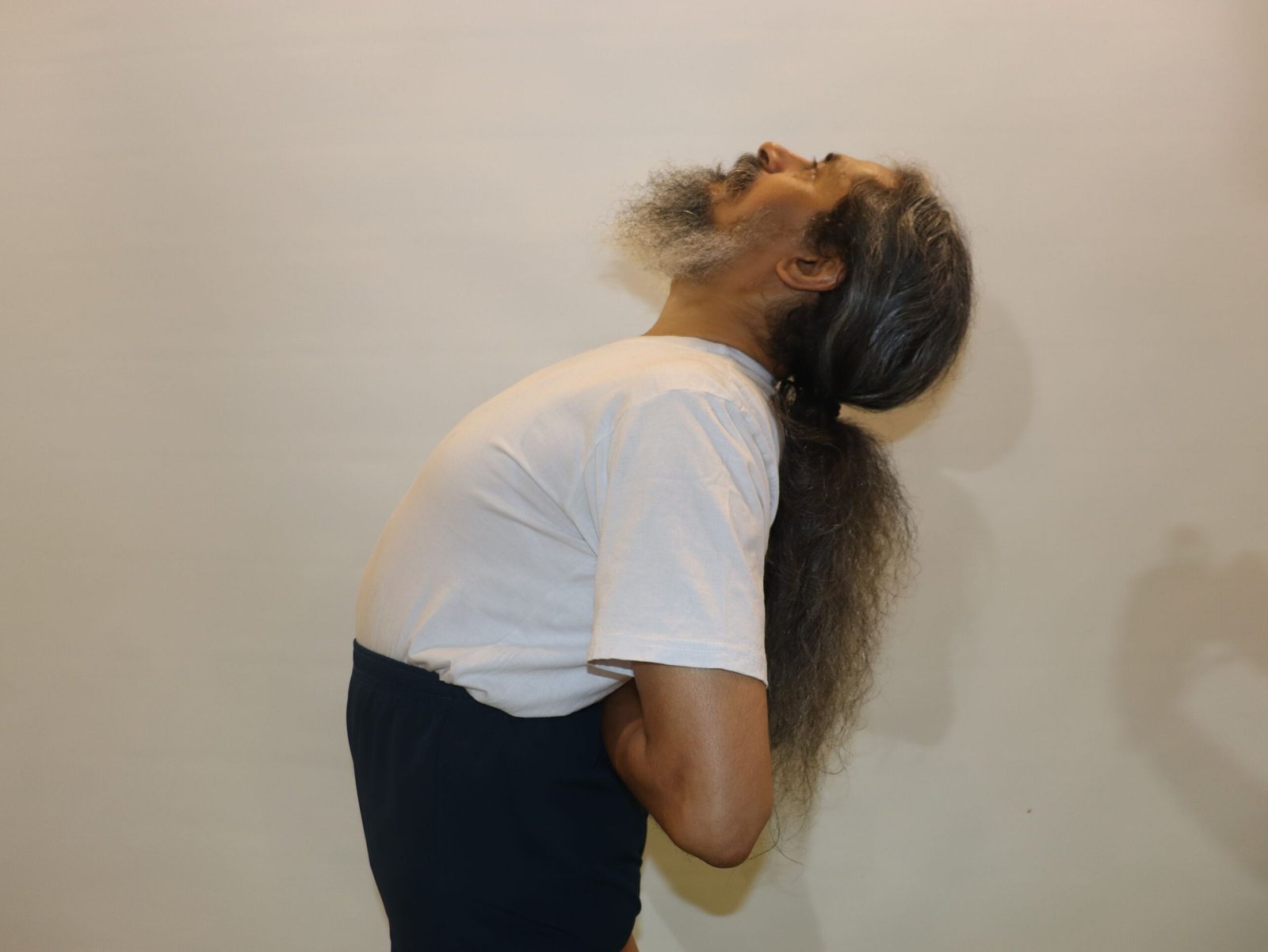
2. Bending Backwards
- Begin inhaling slowly and gently.
- Gradually bend your body backwards, allowing the movement to occur naturally through your back and waist.
- Keep your knees comfortably straight without locking them forcefully.
- Allow your neck to move backwards naturally, without excessive extension.
- Bend only as far as your body comfortably permits.
- Avoid placing unnecessary pressure on your lower back.
Important: Keep your eyes open while bending backwards, as some individuals may experience dizziness or difficulty maintaining balance in this position.
Do not attempt to bend further than your comfortable range of movement.


3. Bending Forwards
- Slowly exhale as you begin bending forwards.
- Bend gently from your hips and waist.
- Keep your spine as comfortably elongated as possible while moving forwards.
- Lower your upper body only as far as you can without discomfort.
- Try to keep your knees straight, but allow a slight bend if necessary.
- Avoid pulling or forcing your body into a deeper forward bend.
The backward and forward movements together complete one cycle.
Recommended Duration and Repetitions
In the traditional method of this exercise, practitioners may gradually work towards taking approximately 30 seconds for the backward movement and 30 seconds for the forward movement.
Up to three cycles may be practised, depending on individual capacity and experience.
However, beginners should start with shorter, comfortable movements rather than attempting prolonged breathing or excessively slow movements.
| Practice Component | Recommendation |
|---|---|
| Beginners | Start with 1–2 comfortable cycles |
| Regular practitioners | Up to 3 cycles, according to capacity |
| Backward bending | Inhale gently |
| Forward bending | Exhale gently |
| After completing the exercise | Rest for approximately 1 minute |
Important: Never force your breathing to match a particular duration. If coordinating your breath with the movement becomes difficult, continue breathing naturally.
Easy Modifications for Beginners
If you are practising Kati Shakti Vikasak for the first time, follow these simple recommendations:
- Maintain a comfortable stance: If standing with your feet together affects your balance, keep them slightly apart.
- Limit your range of movement: Bend forwards and backwards only as far as you can comfortably manage.
- Begin with fewer repetitions: One or two cycles are sufficient initially.
- Increase gradually: Allow your body to adapt before increasing the number of cycles.
- Coordinate your breathing: Focus on inhaling while bending backwards and exhaling while bending forwards.
- Avoid breath-holding: Keep your breathing smooth and natural throughout the practice.
- Move without jerks: Maintain slow, controlled movements rather than sudden or forceful bending.
Remember, progress in yoga is not measured by how deeply you bend or how long you hold a position.


Correct technique, comfortable breathing and awareness of your body’s limitations are far more important.
Major Benefits of Kati Shakti Vikasak
When performed regularly with proper technique, Kati Shakti Vikasak may offer several benefits.
1. Activates and Supports Lower Back Muscles
The forward and backward movements engage various muscles surrounding the waist and lower back.
Regular, controlled practice may help improve muscular activation, functional strength and movement control in these regions.
2. Helps Maintain Spinal Flexibility
A healthy range of spinal movement is important for everyday activities such as bending, standing and reaching.
Kati Shakti Vikasak involves controlled spinal flexion and extension, which may help maintain natural spinal mobility and flexibility.
3. Supports Better Body Posture
Prolonged sitting, poor movement habits and inadequate muscular conditioning can affect posture.
This exercise may improve awareness of spinal positioning and encourage better control of the muscles involved in maintaining an upright posture.
4. Engages Abdominal and Waist Muscles
During forward and backward bending, the abdominal and surrounding trunk muscles contribute to controlling and stabilising the movement.
This may help improve muscular engagement and coordination around the waist.
5. May Improve Balance and Body Coordination
The practice encourages coordination between breathing, movement and balance.
With regular practice, it may help improve body awareness, movement control and overall physical coordination.
Can Kati Shakti Vikasak Reduce Belly Fat?
Kati Shakti Vikasak activates muscles around the waist and abdomen. However, there is no reliable evidence that this exercise alone can specifically reduce belly fat or fat around the waist.
Fat reduction depends on several factors, including overall physical activity, dietary habits, energy balance, sleep and general lifestyle.
For healthy weight management, this exercise can be included as part of a balanced fitness and wellness routine.
Important Precautions While Practising Kati Shakti Vikasak
Although Kati Shakti Vikasak is a controlled yogic movement, certain precautions are necessary to practise it safely.
1. Lower Back or Spinal Pain
If you experience pain in your lower back or spine during the exercise, stop immediately. Do not continue through pain.
2. Slipped Disc, Sciatica or Serious Spinal Conditions
Individuals with a slipped disc, sciatica or other significant spinal disorders should not practise this exercise without consulting a qualified healthcare professional and an experienced yoga expert.
3. Pregnancy
Pregnant women should consult their healthcare provider and a qualified prenatal yoga instructor before attempting this type of forward and backward bending exercise.
4. Dizziness or Balance Problems
Keep your eyes open while bending backwards.
Some people may experience dizziness or lose their balance during backward bending. If you are prone to dizziness, avoid this movement unless a qualified professional has assessed it as appropriate.
5. Avoid Sudden Movements
Never bend forwards or backwards with a jerk. All movements should be gradual, smooth and controlled.
6. Do Not Overstretch
Avoid pushing your body beyond its comfortable range of movement. Excessive bending may place unnecessary stress on the lower back, neck or surrounding tissues.
7. Maintain Natural Breathing
Do not hold your breath or force prolonged inhalation or exhalation.
If you experience sharp pain, numbness, tingling, dizziness or any unusual discomfort, stop the exercise and seek appropriate medical advice.
Important Tips for Safe and Effective Practice
The purpose of Kati Shakti Vikasak is not to bend the body as far as possible. Instead, the objective is to gradually develop mobility, muscular control and awareness through comfortable, coordinated movements.
Every individual has a different level of flexibility, strength and physical fitness. Age, previous injuries, lifestyle and existing health conditions may also influence the appropriate range of movement.
Therefore, avoid comparing your flexibility with that of other practitioners.
Focus on maintaining a comfortable posture, natural breathing and controlled movement.
Regularity, patience and mindful practice are essential for long-term progress in yoga.
Conclusion
Kati Shakti Vikasak is a traditional yoga exercise that focuses on activating the muscles around the waist and lower back while encouraging spinal mobility, flexibility and better body awareness.
Its distinctive feature is the coordination of forward and backward bending movements with breathing.
When performed correctly and within one’s physical capacity, regular practice may help support muscular function, movement control, posture and overall physical well-being.
The key to effective yoga practice is not performing increasingly difficult movements, but developing consistency, awareness, balance and control.
Yogacharya Dhakaram
Founder — YogaPeace Sansthan
