



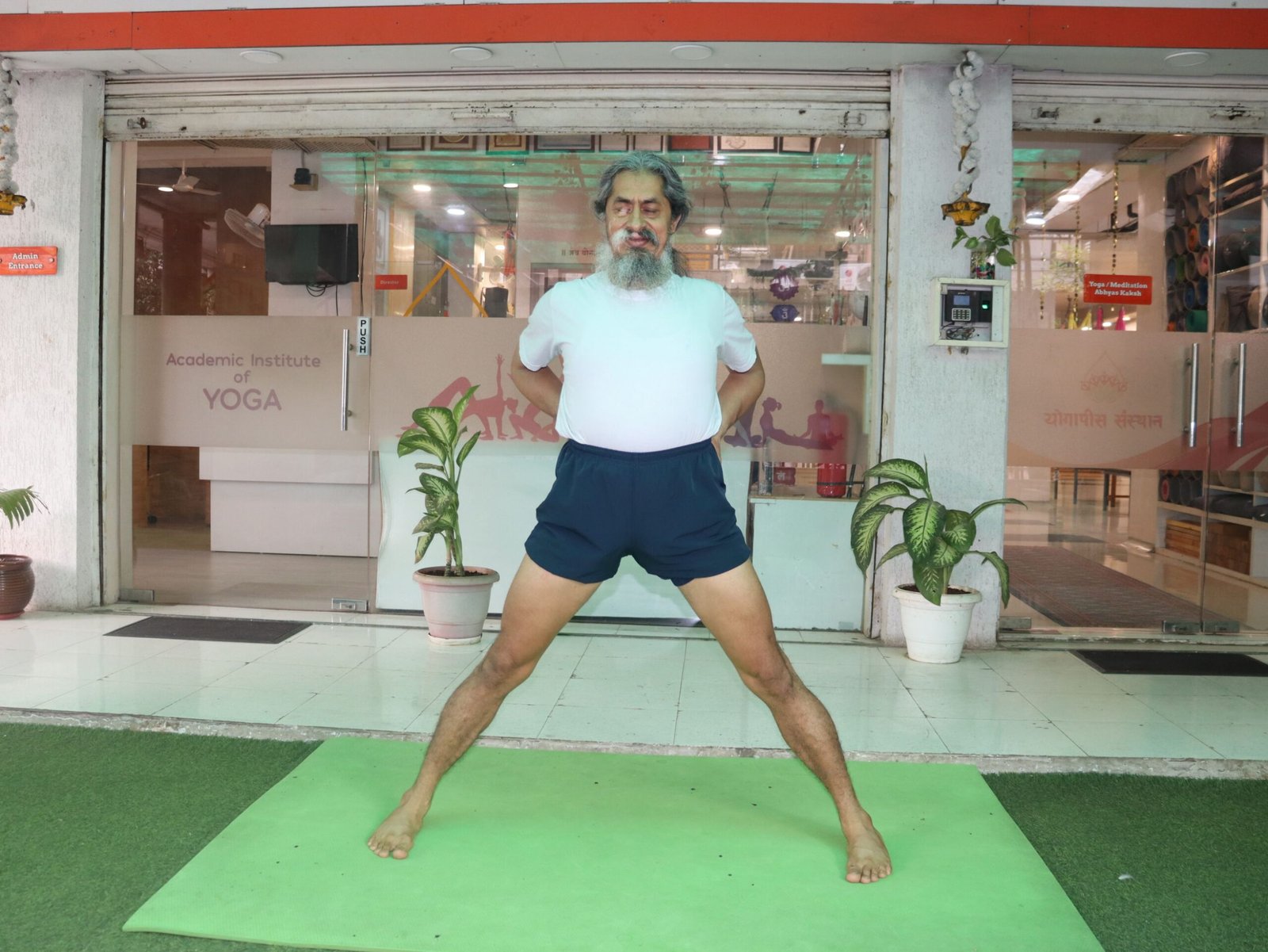
Kati Shakti Vikasak Part 2 is an important exercise in the traditional Sukshma Vyayama (Yogic Subtle Exercises) system. It focuses on activating the muscles surrounding the lower back, improving spinal mobility, and developing strength, flexibility and coordination in the lower body.
The Sanskrit term Kati means waist or lower back, Shakti means strength or power, and Vikasak means that which develops or enhances. Therefore, Kati Shakti Vikasak refers to an exercise designed to develop the strength, flexibility and physical conditioning of the waist and lower back.
The distinctive feature of Kati Shakti Vikasak Part 2 is its wide-legged standing position, followed by controlled backward and forward bending movements. These movements engage the muscles of the lower back, spine, pelvis, hips and legs.
When practised regularly and with proper technique, this exercise may help improve muscular flexibility, spinal mobility, body awareness, and postural coordination. Additionally, it may help you develop better control over your movements and maintain a more balanced posture.


Starting Position for Kati Shakti Vikasak Part 2
Before beginning the exercise, it is essential to establish a stable and comfortable standing position. Proper alignment helps maintain balance and reduces unnecessary strain on the muscles and joints.
1. Position of the Feet
- Stand upright with your body relaxed.
- Spread your feet approximately 3 to 4 feet apart, adjusting the distance according to your height, flexibility and comfort.
- Keep both soles firmly and evenly placed on the ground.
- Turn your toes slightly inward and your heels outward, ensuring that the position does not create discomfort in the knees or ankles.
- Distribute your body weight equally between both feet.
2. Position of the Hands
- Place both palms firmly on your waist.
- Keep the four fingers of each hand pointing backward towards the spine.
- Position both thumbs towards the front of the abdomen.
- Maintain gentle support around the waist without applying excessive pressure.
3. Body Alignment
- Keep your head and neck comfortably upright.
- Relax your shoulders and avoid unnecessary tension.
- Maintain the natural alignment of your spine.
- Look straight ahead and breathe normally.
Step-by-Step Procedure for Kati Shakti Vikasak Part 2
This exercise consists of two principal movements: backward bending and forward bending. Both movements should be performed slowly, smoothly and in coordination with the breath.
Step 1: Backward Bending
- Stand in the starting position with your hands resting on your waist.
- Slowly inhale deeply through your nose. In yogic terminology, inhalation is called Puraka.
- As you inhale, gradually begin bending your body backward.
- Keep your knees as straight as comfortably possible without forcefully locking them.
- Allow the movement to develop gradually rather than forcing the lower back into an excessive arch.
- Bend backward only as far as your body comfortably permits.
- Keep your eyes open, particularly during the initial stages, to maintain balance and minimise the possibility of dizziness.
- Hold the position briefly if comfortable. Experienced practitioners may gradually work towards maintaining the posture for approximately 20–30 seconds, provided there is no pain or discomfort.
Important: Do not hold your breath forcefully while maintaining the backward bend. Continue breathing naturally and comfortably.
Step 2: Forward Bending
- Slowly return your body to the upright position.
- Begin exhaling gently through your nose. In yogic terminology, exhalation is called Rechaka.
- As you exhale, gradually bend forward from your hips.
- Lower your upper body towards the ground in a slow, controlled movement without jerking.
- Traditionally, the objective is to bring the forehead or chin towards the ground. However, touching the ground is not necessary.
- Bend only as far as your flexibility and physical condition comfortably allow.
- Keep both hands positioned on your waist throughout the movement. Avoid shifting them onto your thighs or knees.
- If comfortable, remain in the forward-bending position for approximately 20–30 seconds. Beginners should start with shorter durations.
- Continue breathing naturally while holding the position.


Important: Avoid overstretching the hamstrings or forcing the knees into a rigid position. A slight bend in the knees may be maintained if necessary to prevent excessive strain.
Step 3: Returning to the Starting Position
- Inhale slowly and gradually raise your upper body.
- Return to an upright standing position.
- Re-establish your balance and normal breathing.
- When comfortable, begin the next backward-bending movement.


One complete backward and forward bending sequence constitutes one round of the exercise.
Recommended Repetitions and Concentration
Kati Shakti Vikasak Part 2 may generally be repeated 3 to 5 times, depending on the practitioner’s physical condition, experience and comfort.
Beginners should start with fewer repetitions and gradually increase the duration and intensity of the exercise.
During practice:
- Maintain slow, smooth and controlled movements.
- Coordinate your breathing naturally with each movement.
- Avoid bending beyond your comfortable range of motion.
- Take a short rest between repetitions whenever necessary.
- Remain attentive to the sensations in your lower back, spine, hips and legs.
As practitioners become more experienced, they should develop greater awareness of their breathing and bodily movements.
Although traditional yogic practices sometimes encourage closing the eyes to improve concentration, keeping the eyes open is safer during this exercise, especially while bending backward. Closing the eyes should only be considered in a stable, supported position under appropriate supervision.
Importance of Breathing in Kati Shakti Vikasak Part 2
Breathing plays an essential role in yogic exercises. It helps coordinate physical movements, supports concentration and encourages greater awareness of the body.
1. Inhalation During Backward Bending (Puraka)
During backward bending, inhaling gradually encourages the expansion of the chest and creates a sensation of opening along the front of the body.
This movement may help:
- Encourage chest expansion.
- Improve coordination between breathing and physical movement.
- Engage the muscles supporting the spine.
- Develop greater awareness of posture and balance.
However, deep inhalation should not be assumed to reduce pressure on the intervertebral discs. The forces acting on spinal structures depend on several factors, including posture, movement and individual anatomy.
2. Exhalation During Forward Bending (Rechaka)
During forward bending, slow exhalation may help practitioners move more comfortably and maintain better control.
This movement involves:
- Stretching the muscles of the lower back.
- Lengthening the hamstrings at the back of the thighs.
- Changing the position of the abdominal and pelvic regions.
- Developing coordination between breathing and spinal movement.
Allow the abdomen to move naturally during exhalation without forcefully contracting the abdominal muscles.

Health Benefits of Kati Shakti Vikasak Part 2
The potential benefits of this exercise are primarily associated with muscular flexibility, spinal mobility, balance and physical coordination.
1. Improves Lower Back and Spinal Mobility
The controlled forward and backward bending movements encourage mobility in different regions of the spine.
Regular practice within a comfortable range may help maintain flexibility in the muscles surrounding the lower back and improve general spinal movement.
2. Activates the Back and Pelvic Muscles
The wide-legged standing position requires the muscles of the waist, hips and pelvic region to work together to maintain stability.
This can help develop muscular coordination and awareness of the body’s supporting structures.
3. Enhances Hamstring Flexibility
During forward bending, the hamstring muscles located at the back of the thighs undergo a stretching movement.
With regular, controlled practice, this may help improve hamstring flexibility and reduce general muscular tightness.
4. Supports Better Posture and Waist Conditioning
The exercise engages muscles surrounding the waist and trunk, helping practitioners become more aware of their body alignment.
It may contribute to overall physical conditioning when included in a balanced exercise routine.
However, this exercise alone cannot specifically eliminate abdominal fat or fat around the waist, commonly known as love handles. Fat reduction depends on overall energy balance, physical activity, nutrition and lifestyle habits.
5. May Reduce General Muscular Stiffness
Prolonged sitting and physical inactivity can contribute to stiffness in the lower back, hips and legs.
Gentle mobility exercises may help reduce ordinary muscular tightness and improve ease of movement.
However, individuals experiencing sciatica or nerve-related pain should exercise caution, as forward bending may aggravate symptoms in some cases.
6. Encourages Movement in the Abdominal Region
The alternating forward and backward movements change the position of the abdominal muscles and surrounding tissues.
In traditional yoga, such movements are considered helpful for activating the abdominal region.
However, there is insufficient scientific evidence to conclude that this exercise directly massages the kidneys or liver or improves the functioning of specific internal organs.
7. Develops Balance and Body Awareness
Maintaining a wide-legged stance while coordinating breathing and movement encourages practitioners to become more conscious of their posture, balance and muscular engagement.
This awareness may contribute to improved physical coordination during everyday activities.

Precautions and Contraindications
Kati Shakti Vikasak Part 2 involves considerable movement of the spine. Therefore, it should be practised carefully, particularly by individuals with existing medical conditions.
- High Blood Pressure: Individuals with uncontrolled hypertension should avoid deep bending and breath-holding unless cleared by a healthcare professional.
- Slipped Disc or Disc-Related Conditions: Forward or backward bending may aggravate certain spinal disc problems. Medical advice is recommended before attempting the exercise.
- Sciatica: If pain, tingling or numbness radiates from the lower back into the legs, discontinue the exercise and seek professional evaluation.
- Hernia: Individuals with abdominal or related hernias should obtain medical guidance before performing deep bending movements.
- Dizziness or Balance Disorders: Take particular care during backward bending. Stop immediately if dizziness occurs.
- Pregnancy: Deep forward and backward bending may require modification or avoidance, particularly during later stages of pregnancy. Seek guidance from a qualified prenatal yoga professional.
- Osteoporosis or Previous Spinal Surgery: Individuals with these conditions should not attempt deep spinal bending without appropriate medical clearance.
Never force your body into a position. Stop immediately if you experience sharp pain, unusual discomfort, numbness, tingling or dizziness.
Tips for Safe and Effective Practice
The effectiveness of Kati Shakti Vikasak Part 2 should not be measured by how far you can bend. Proper technique, controlled movement, comfortable breathing and consistency are more important than achieving an extreme range of motion.
Beginners may start with a narrower stance and smaller bending movements. As flexibility and body awareness improve, the range of movement can be increased gradually.
A gentle warm-up before beginning the exercise may help prepare the muscles and joints. It is also advisable to avoid deep forward and backward bending immediately after a heavy meal.
Practising under the guidance of an experienced yoga teacher can help ensure proper alignment and reduce the risk of unnecessary strain.
Conclusion
Kati Shakti Vikasak Part 2 is a traditional yogic exercise that focuses on developing mobility, flexibility and muscular coordination in the waist, lower back and surrounding regions.
Its distinctive wide-legged standing position, combined with controlled backward and forward bending, encourages the activation of several muscle groups while developing greater awareness of breathing and posture.
The true purpose of this practice is not to bend the body as far as possible, but to develop strength, stability, flexibility and coordination through mindful movement.
With regular practice, proper technique and respect for individual physical limitations, Kati Shakti Vikasak Part 2 can become a valuable addition to a balanced yoga routine.
Yogacharya Dhakaram
Founder, YogaPeace Sansthan
